



Close Menu
باب مصرباب مصر

    Subscribe to Updates

    Get the latest creative news from FooBar about art, design and business.

    What's Hot

    The Woven Skeleton: The Palm Frond Artisans of Kafr Al-Battikh Fend Off a Plastic Tide

    2026-05-14

    The Sanctuary of Saint Bishoy: A Living Ledger of Egyptian Monasticism

    2026-05-13

    Shadows Over the Nile: Concrete Construction Spark Criticism Beneath the Temple of Kalabsha

    2026-05-13
    Facebook X (Twitter) Instagram
    Facebook X (Twitter) Instagram YouTube LinkedIn
    باب مصرباب مصر
    Contact US
    باب مصرباب مصر
    Home»Upper Egypt»The Ramadan Dish That Starts in the Sheep’s Pasture: Alfalfa Rice of Kharga
    Upper Egypt

    The Ramadan Dish That Starts in the Sheep’s Pasture: Alfalfa Rice of Kharga

    Moussa AdelBy Moussa Adel2026-03-19Updated:2026-05-20No Comments4 Mins Read0 Views
    Facebook Twitter Pinterest LinkedIn Tumblr Email
    Share
    Facebook Twitter LinkedIn Pinterest WhatsApp Email

     In the Kharga Oasis, Ramadan iftar means rice cooked with fresh alfalfa, garlic, and desert spices. Passed down through generations and cooked over wood fires, this ancient dish is a taste of oasis identity.

    Modern stoves have arrived in the Kharga Oasis. But they have not displaced the old ways.

    In the villages of Egypt’s New Valley Governorate, families still insist on cooking certain dishes over the traditional kanoun clay oven. And chief among those dishes is a unique oasis creation known as roz al-khodar, or “vegetable rice.” Its essential ingredient is not a vegetable in the usual sense. It is fresh alfalfa, the same crop grown to feed livestock.

    This dish is not merely food. It is a symbol of oasis identity, a piece of inherited tradition that appears on every family’s Ramadan table.

    Alfalfa: From Field to Pot

    The story begins at dawn, when the grandson of Hajja Fatma Qandil heads to the field. This time, he is not bringing feed for the animals. He is selecting the finest cuttings of fresh alfalfa for his grandmother to use in preparing the distinctive rice dish unique to Kharga and its villages.

    Mamoud Daniel, an artist from the village of Munira who documents oasis heritage, speaks of the dish with evident nostalgia.

    “For us, alfalfa rice is not just ordinary iftar food during Ramadan. It is my favorite meal. This dish calls to us from afar. It reminds us of family gatherings, of the time of goodness when we were small. The day we cooked alfalfa rice was a holiday. The smell filled the streets and houses of Munira.”

    “In Kharga specifically,” he adds, “alfalfa rice is our main iftar dish during Ramadan. Prepared with garlic, onion, and coriander, it has a completely different taste. It is what gives you energy and refreshment after a day of fasting in the desert heat.”
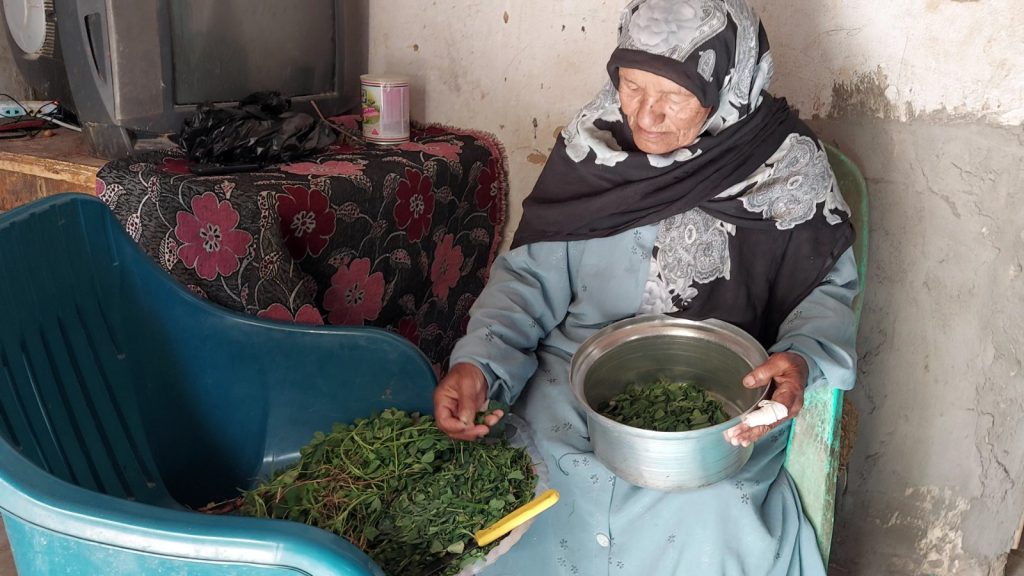
     Preparing alfalfa rice. Photo credit: Hadeer Mahmoud

    “Anything Modern Is Foreign to Us”

    In the village of Munira, near the ruins of old houses, sits Hajja Fatma Qandil. An octogenarian whose eyes still sparkle, she refuses to have anything to do with modern technology. Gas stoves, in her view, are foreign intruders that ruined the taste of traditional oasis cooking.

    Holding a hand grinder, she explains.

    “Oasis food needs soul and blessing. We lost both when we abandoned the kanoun. I remember the old days when we made this alfalfa rice over a wood fire and cooked it in the tabouna, the old village oven. The smell would reach whoever was at the far end of the village. We bring the alfalfa from the field. We pick only the small, tender leaves. We throw the stalks to the sheep. We wash it well, then grind it by hand just like mulukhiya until it becomes soft in our hands.”

    How to Make Alfalfa Rice

    Hajja Fatma reveals the secrets that make this dish distinctive.

    “We start by taking garlic, an onion, and some dried coriander. We pound them in a copper mortar. Never use a blender. The mortar makes the garlic’s aroma come out properly and seals the dish. We put boiling water on the fire and add the ground alfalfa. Then we add the mixture we pounded in the mortar with a piece of local clarified butter. And oh, the smell.”

    She continues, “This alfalfa rice loves harmony. Its ingredients must blend together. As soon as you see the ground alfalfa leaves start to boil and swirl in the water with the onion, garlic, and coriander mixture, and the smell fills the place, then comes the most important step. We add the washed rice, lower the fire, and stir gently until everything absorbs each other and cooks slowly.”

    “When it starts to boil, we add the rice, stir gently, cover the pot, and leave it on the lowest possible fire until the rice absorbs the spirit of the alfalfa and cooks through. Then you see the rice has turned light green. The taste is like nothing else.”
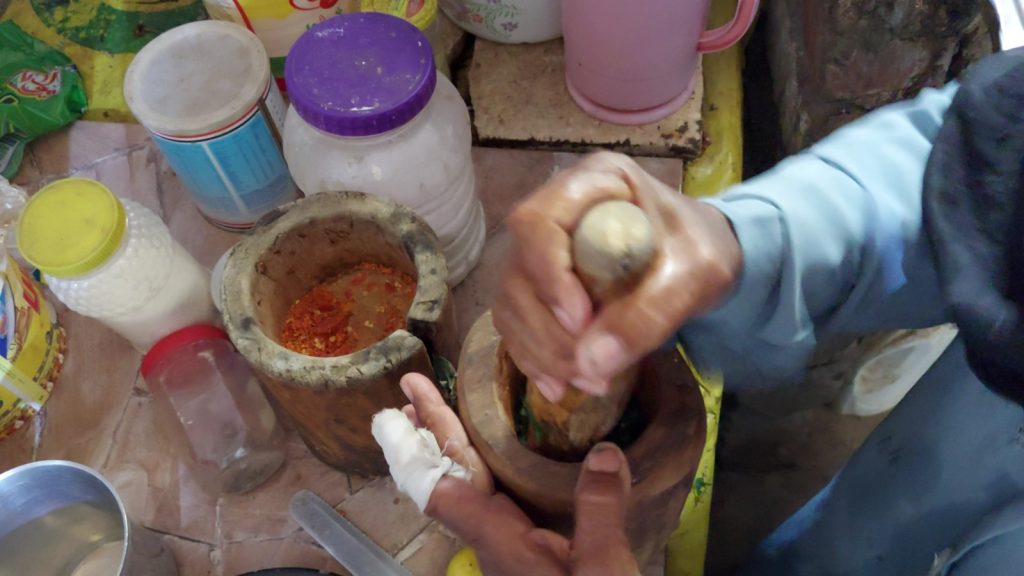
     Preparing alfalfa rice. Photo credit: Hadeer Mahmoud

    The Historical Significance of Oasis Cooking

    Dr. Mohamed Abdullah Al-Bayarsi, a researcher in popular heritage and traditions, places alfalfa rice in its proper context.

    “This is not just a recipe,” he says. “It is a historical record of the oasis dweller’s intelligence in exploiting available resources. During periods of historical isolation, reliance on what the land produced was the key to survival.”

    The dish, he explains, became associated with harvest seasons and village celebrations. Its nutritional value is significant. Alfalfa is rich in minerals and vitamins. This likely explains the physical strength for which the people of Kharga were historically known.

    Alfalfa rice recipe Egyptian oasis cooking Kharga Oasis cuisine New Valley Governorate food roz al-khodar traditional Ramadan dishes
    Share. Facebook Twitter Pinterest LinkedIn Tumblr Email
    Previous ArticleWhere the Whole Neighborhood Bakes: Minya’s Communal Eid Cookie Tradition
    Next Article What Does Eid Smell Like? In Damanhour, It’s Salted Fish.
    Moussa Adel

    Related Posts

    The Sanctuary of Saint Bishoy: A Living Ledger of Egyptian Monasticism

    2026-05-13

    Shadows Over the Nile: Concrete Construction Spark Criticism Beneath the Temple of Kalabsha

    2026-05-13

    The Last Cobblers of Luxor: A Craft Contesting the Modern Tide

    2026-05-10

    Comments are closed.

    Recent Posts
    • The Woven Skeleton: The Palm Frond Artisans of Kafr Al-Battikh Fend Off a Plastic Tide
    • The Sanctuary of Saint Bishoy: A Living Ledger of Egyptian Monasticism
    • Shadows Over the Nile: Concrete Construction Spark Criticism Beneath the Temple of Kalabsha
    • The Damanhur Opera House: A Sovereign Union of Italian Elegance and Islamic Heritage
    • The Silent Outposts of Port Said: Ruins Beyond the Reach of Visitors
    Recent Comments
    • Binance美国注册 on An exhibition in Paris reimagines Cleopatra, far from Western narratives
    • binance "oppna konto on An exhibition in Paris reimagines Cleopatra, far from Western narratives
    • código de referencia de Binance on Art exhibition documents the first Egyptian Scout postage stamp at the National Museum of Civilization
    • Binance账户创建 on Between popular religiosity and the benevolence of the Quran, how can beauty be reconnected with “Sayyida Zeinab”?
    • phoenix game on Theater never dies… Mansoura saves its heritage and restores it as an opera house
    About Us
    About Us

    Your source for the lifestyle news. This demo is crafted specifically to exhibit the use of the theme as a lifestyle site. Visit our main page for more demos.

    We're accepting new partnerships right now.

    Email Us: info@example.com
    Contact: +1-320-0123-451

    Facebook X (Twitter) Pinterest YouTube WhatsApp
    Our Picks

    The Woven Skeleton: The Palm Frond Artisans of Kafr Al-Battikh Fend Off a Plastic Tide

    2026-05-14

    The Sanctuary of Saint Bishoy: A Living Ledger of Egyptian Monasticism

    2026-05-13

    Shadows Over the Nile: Concrete Construction Spark Criticism Beneath the Temple of Kalabsha

    2026-05-13
    Most Popular

    Shadows Over the Nile: Concrete Construction Spark Criticism Beneath the Temple of Kalabsha

    2026-05-135 Views

    The Sanctuary of Saint Bishoy: A Living Ledger of Egyptian Monasticism

    2026-05-132 Views

    The Healing Arteries of Dakhla: Harnessing the Geothermal Riches of the New Valley

    2026-05-062 Views
    Demo
    Latest Posts

    The Woven Skeleton: The Palm Frond Artisans of Kafr Al-Battikh Fend Off a Plastic Tide

    2026-05-140 Views

    The Sanctuary of Saint Bishoy: A Living Ledger of Egyptian Monasticism

    2026-05-132 Views

    Shadows Over the Nile: Concrete Construction Spark Criticism Beneath the Temple of Kalabsha

    2026-05-135 Views

    The Damanhur Opera House: A Sovereign Union of Italian Elegance and Islamic Heritage

    2026-05-111 Views
    Stay In Touch
    • Facebook
    • Twitter
    • Pinterest
    • Instagram
    • YouTube
    • Vimeo
    Don't Miss

    Shadows Over the Nile: Concrete Construction Spark Criticism Beneath the Temple of Kalabsha

    By Bab Masr2026-05-13

    A controversy erupts in Aswan as new concrete structures at the Temple of Kalabsha spark…

    The Sanctuary of Saint Bishoy: A Living Ledger of Egyptian Monasticism

    2026-05-13

    The Healing Arteries of Dakhla: Harnessing the Geothermal Riches of the New Valley

    2026-05-06

    Subscribe to Updates

    Get the latest creative news from SmartMag about art & design.

    Demo
    Demo
    Latest Posts

    The Woven Skeleton: The Palm Frond Artisans of Kafr Al-Battikh Fend Off a Plastic Tide

    2026-05-140 Views

    The Sanctuary of Saint Bishoy: A Living Ledger of Egyptian Monasticism

    2026-05-132 Views

    Shadows Over the Nile: Concrete Construction Spark Criticism Beneath the Temple of Kalabsha

    2026-05-135 Views

    The Damanhur Opera House: A Sovereign Union of Italian Elegance and Islamic Heritage

    2026-05-111 Views
    Stay In Touch
    • Facebook
    • Twitter
    • Pinterest
    • Instagram
    • YouTube
    • Vimeo
    Don't Miss

    Shadows Over the Nile: Concrete Construction Spark Criticism Beneath the Temple of Kalabsha

    By Bab Masr2026-05-13

    A controversy erupts in Aswan as new concrete structures at the Temple of Kalabsha spark…

    The Sanctuary of Saint Bishoy: A Living Ledger of Egyptian Monasticism

    2026-05-13

    The Healing Arteries of Dakhla: Harnessing the Geothermal Riches of the New Valley

    2026-05-06

    Subscribe to Updates

    Get the latest creative news from SmartMag about art & design.

    Demo
    About Us
    About Us

    Your source for the lifestyle news. This demo is crafted specifically to exhibit the use of the theme as a lifestyle site. Visit our main page for more demos.

    We're accepting new partnerships right now.

    Email Us: info@example.com
    Contact: +1-320-0123-451

    Facebook X (Twitter) Pinterest YouTube WhatsApp
    Our Picks

    The Woven Skeleton: The Palm Frond Artisans of Kafr Al-Battikh Fend Off a Plastic Tide

    2026-05-14

    The Sanctuary of Saint Bishoy: A Living Ledger of Egyptian Monasticism

    2026-05-13

    Shadows Over the Nile: Concrete Construction Spark Criticism Beneath the Temple of Kalabsha

    2026-05-13
    Most Popular

    Shadows Over the Nile: Concrete Construction Spark Criticism Beneath the Temple of Kalabsha

    2026-05-135 Views

    The Sanctuary of Saint Bishoy: A Living Ledger of Egyptian Monasticism

    2026-05-132 Views

    The Healing Arteries of Dakhla: Harnessing the Geothermal Riches of the New Valley

    2026-05-062 Views
    © 2026 ThemeSphere. Designed by ThemeSphere.

    Type above and press Enter to search. Press Esc to cancel.