



In this interview, Dyna Eldaief discusses her cookbook “The Taste of Egypt,” the misconceptions foreigners have about Egyptian cuisine, and why she’s on a mission to preserve family recipes for new generations.
When did your relationship with cooking transform from daily routine into something deeply personal?
The moment I left home for university. Before that, my mother always cooked for the family. Even after I moved into the dormitories, she kept cooking for me, freezing meals in small containers so I wouldn’t go without her food during the week. Sharing those meals with my friends, and later with my husband, made me realise how deeply food connects people.
Being three hours away from home, I also craved the flavours I grew up with. That longing pushed me to learn how to cook properly. What started as a necessity quickly became a passion, and then a way to hold onto parts of my identity that I hadn’t fully appreciated as a child.
You’ve traveled widely and experienced many different cuisines. Why did you choose Egyptian food as the focus of your book?
Egyptian food is the language of my childhood. I enjoy exploring other cuisines, but nothing gives me the same sense of belonging as Egyptian dishes. They carry stories about my mother, my father’s favorite meals, summers when we dried eggplants under the sun, family gatherings, and quiet dinners at home.
When people would ask, “What do Egyptians actually eat?” I realised how underrepresented our cuisine is internationally. Writing this book felt like a way to honor my family, share our traditions, and give Egyptian food the place it deserves on the global table.
Who is your primary audience—foreign readers or Egyptians?
Both, but in different ways. For Egyptians, especially those living abroad, the book is a way to reconnect with the flavours of home. I believe that traditional Egyptian recipes aren’t being passed down between generations the way they used to be.
For international readers, the book opens a door to a cuisine that is often overlooked, despite its deep history and rich flavors. I wrote it hoping that anyone, regardless of their background, could pick it up and feel confident cooking Egyptian food in their own kitchen.
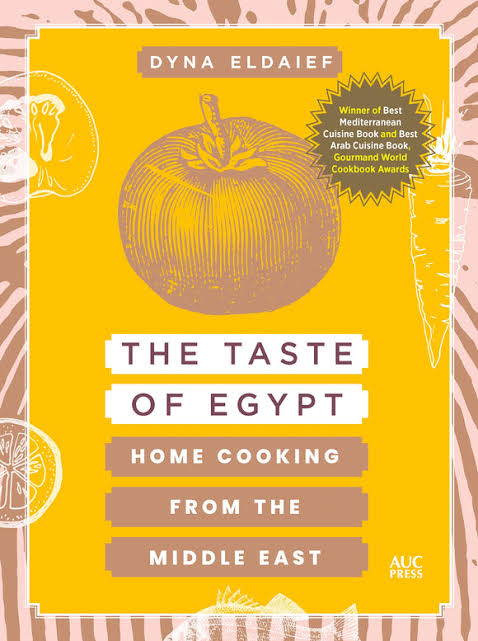
Book cover. Photo courtesy of Dyna ElDaief
How did you choose which recipes to include? What criteria did you use?
I started with the dishes I couldn’t imagine my life without,the ones my mother made that shaped my childhood. Then I added recipes that carried strong memories or represented essential elements of Egyptian home cooking.
I also considered accessibility: Can the reader find these ingredients? Can they recreate the flavor without specialized equipment? The final collection reflects a balance between nostalgia, practicality, and a desire to preserve recipes that might otherwise fade with time.
In your experience, what are the most common misconceptions foreigners have about Egyptian food?
Many people assume Egyptian food is the same as Middle Eastern food generally, or that it’s all heavy, spicy, or complicated. In reality, Egyptian cuisine is regionally diverse, rich in flavor, and deeply comforting in its simplicity.
It relies on humble ingredients,rice, lentils, herbs, tomatoes, meat, that, through generations of technique, become distinctive dishes. Another misconception is that it’s difficult to prepare. People are often surprised by how straightforward it is, how homey and nourishing it feels once they try it.
Your book doesn’t include bread recipes, even though bread is fundamental to Egyptian dining. Was that intentional?
Yes, to some extent. Bread is its own specialized category in Egyptian cooking and deserves dedicated space. Traditional Egyptian bread involves techniques that can be hard to replicate at home.
Also, my mother didn’t bake fresh bread often when I was growing up. I felt that including simplified versions wouldn’t do it justice, so I focused on dishes I could teach with authenticity and confidence. Maybe bread will have its own project someday.
There’s a noticeable emphasis on meat dishes in the book. Is that personal, or does it reflect broader Egyptian hospitality traditions?
Both. In my childhood, meat dishes were central to our table. My parents made sure our family dinners almost always included some form of animal protein.
Because of that, meat became associated in my memory with main meals, celebrations, and family gatherings. Egyptian hospitality is also inherently generous,showing love often means abundance, and meat plays a big role in that. At the same time, some of my strongest food memories are of dishes like kofta, grilled chicken, and liver, so it felt natural to give them prominence.
Your book includes both very traditional recipes and simpler, more modern ones. How did you balance appealing to beginners while including dishes that require more skill?
I wanted the book to feel welcoming, not intimidating. Some recipes, like mulukhiya or stuffed vegetables, take patience and practice. Others are perfect for a quick weeknight meal.
Including both gives readers the chance to start at their own level and build skills over time. I also made sure the instructions were clear and approachable, while still being precise enough to ensure success, so even the more complex dishes feel doable.
Are you considering another book focused on, say, bread or vegetarian dishes?
I wanted “The Taste of Egypt” to be a comprehensive collection. But when I was asked to write “Egyptian Flavours,” I kept the traditional recipes while adding some plant-based alternatives. A purely vegetarian book with a Middle Eastern focus could happen in the future,not limited to one country, but drawing on the flavors and techniques I grew up with.
A bread-focused book is also a possibility, but it would require different research and testing. It’s definitely on the horizon.
Were there recipes you included specifically to preserve them from being forgotten?
Yes,my mother’s coconut cake, for example. She relied on a specific glass for measuring, and I felt it was important to document it before the recipe disappeared.
Some traditional stews and vegetable dishes also felt like recipes younger generations might never encounter unless they were written down. Including them was my way of honoring my mother and making sure those dishes continue.
What single element or ingredient do you feel best represents Egyptian food culture?
For me, it’s the combination of simplicity and generosity. Ingredients like tomatoes, onions, garlic, rice, and herbs appear again and again, yet they transform into rich, comforting meals. Mulukhiya is just a green leaf, but it becomes a dish full of memory and meaning. That ability to create soulful food from simple ingredients,that’s the spirit of Egyptian cooking.
With the cooking workshops you run, how important is hands-on learning for passing traditions to new generations and to non-Egyptians?
Hands-on learning is essential. Egyptian cooking is full of small details,how to roll cabbage leaves, how to adjust seasoning by taste, which you really learn by watching and doing.
Things don’t always go smoothly in the kitchen, so workshops let people experience the reality of it: the smells, the textures, the small adjustments that give a dish its soul. It’s also a beautiful way to share culture. Participants leave not just with recipes, but with memories and stories,and with a deeper appreciation for Egyptian food.
How do you simplify traditional dishes without losing their spirit?
In workshops, I can adapt in real time, explain, answer questions, and adjust based on the group. With a book, I have to anticipate those questions and write instructions clearly enough that readers can follow on their own.
When simplifying, I focus on preserving core flavours and techniques. I might shorten some steps or offer alternatives, but I never want the dish to lose its essence. The goal is always to make Egyptian food accessible without stripping away what makes it special.
