



Close Menu
باب مصرباب مصر

    Subscribe to Updates

    Get the latest creative news from FooBar about art, design and business.

    What's Hot

    The Woven Skeleton: The Palm Frond Artisans of Kafr Al-Battikh Fend Off a Plastic Tide

    2026-05-14

    The Sanctuary of Saint Bishoy: A Living Ledger of Egyptian Monasticism

    2026-05-13

    Shadows Over the Nile: Concrete Construction Spark Criticism Beneath the Temple of Kalabsha

    2026-05-13
    Facebook X (Twitter) Instagram
    Facebook X (Twitter) Instagram YouTube LinkedIn
    باب مصرباب مصر
    Contact US
    باب مصرباب مصر
    Home»Upper Egypt»From Dawn Until the Harvest: Tales of Joy and Toil in the Wheat Fields of Assiut
    Upper Egypt

    From Dawn Until the Harvest: Tales of Joy and Toil in the Wheat Fields of Assiut

    Jasmine MehnaBy Jasmine Mehna2026-05-03Updated:2026-05-20No Comments6 Mins Read0 Views
    Facebook Twitter Pinterest LinkedIn Tumblr Email
    1492267686 477 1328919 3162
    1492267686 477 1328919 3162
    Share
    Facebook Twitter LinkedIn Pinterest WhatsApp Email

    Against the golden backdrop of Assiut, farmers revive ancestral songs and sacred rituals to welcome the wheat harvest. Discover the lyrical journey of toil, community spirit, and the “Khair” that secures the Egyptian household.

    “O goodly wheat.. the time for reaping is here.. Yallah (Come).. the wheat is leveled, it calls for the reapers.. Yallah!” With these ancestral melodies, the people of Assiut inaugurate the wheat harvest season. With the first glimmer of dawn, farmers depart for their lands with hearts brimming with hope and saturated with joy, amidst stalks of wheat that shimmer like gold, beginning a season of harvest that carries the “Khair” (bountiful goodness) awaited by every household.
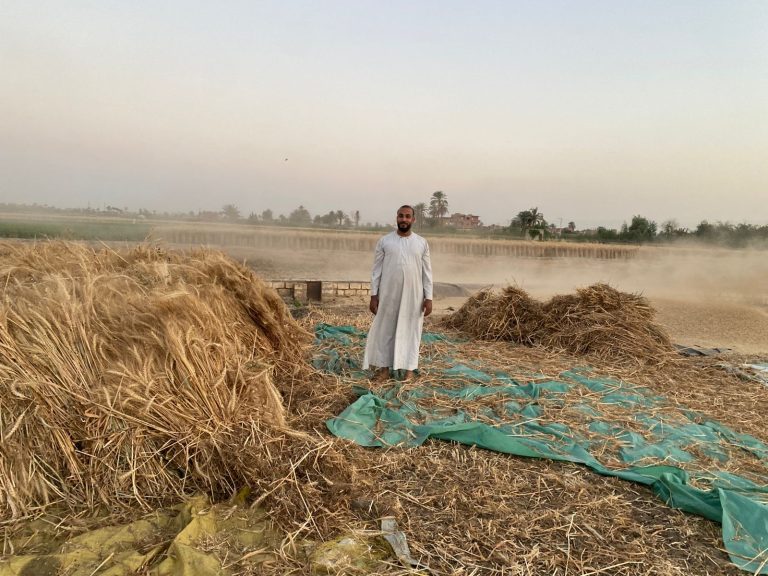
    e0aca724 de4a 48cf a81c 28ea333029de 768x576
    The wheat harvest. Photo: Jasmine Mehna

    The Toil of the Reaping

    “The wheat tonight celebrates its feast.. O Lord, bless it and increase it.. Pearls and sweets upon its stalks. The world’s existence is from its generosity. O Lord, may it never miss its season. O Lord, bless it and increase it.” With overwhelming delight, Najat Ali, 50, greets the wheat crop with this song, her voice rising across her land as the harvest commences.

    Ali says, “This is the season of happiness, contentment, and grace. Wheat is God’s veil of protection and His bounty upon us from His earth; it is our reservoir of security throughout the year. As long as there is wheat in the house, every hardship is eased. We rejoice and bring joy to our loved ones, and the goodness encompasses everyone by God’s grace.” Nearby, Fares Mahmoud, 30, ventures to his field carrying the exhaustion of an entire year upon his shoulders, his hope unyielding for a prolific harvest. He remarks, “I wake immediately after dawn. As soon as I finish my prayers, I dress and head to the land. This day is unlike any other; this is the harvest of “Khair,” and God compensates us today for the weariness of the entire year.”

    Fares walks among the wheat stalks that glisten as if they were threads of gold, beginning his day with his simple “Minjal” (hand-held sickle), in a tableau that unites grit and beauty: “The moment I enter the field and see the stalks standing tall like that, I swear I feel an unnatural joy. I tell myself: Praise be to God, our exhaustion did not go to waste.”

    Despite the simplicity of the tools, the labour remains gruelling, as the hours of reaping stretch beneath the sun’s rays, yet a spirit of “Rida” (contentment) remains anchored in his heart: “The work is not easy, of course. The sun becomes searingly hot, and our hands might be cut, but we endure. This is our “Rizq” (divine provision), and when one toils for something they love, the exhaustion becomes light.”
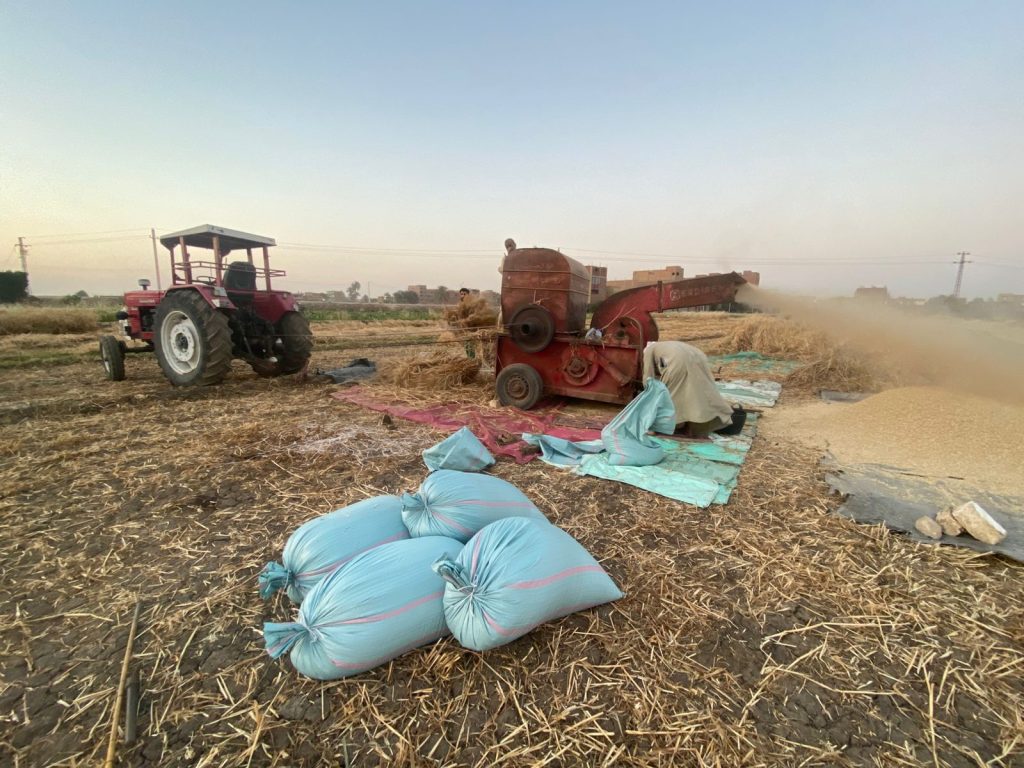
    c0b6beca 1f85 41a8 a535 8289f32c08f9
    The Wheat Harvest Season in Assiut – Photo: Jasmine Mehna

    Melodies of the Harvest

    “Cut, O sickle, and sing.. for the goodness is entering with a song.. our provision is from our land.. and our Lord always grants us peace.. O stalks held high.. O our precious provision.. the day of harvest is a joy.. that makes one forget all the nights that passed.”

    Fares notes: “We sing while we work. Singing makes the time pass swiftly and keeps one spirited even amidst the fatigue.” He continues with a voice saturated with warmth: “The most beautiful part is when we bring the wheat home. When the first “Shuwal” (burlap sack) enters, greeted by my mother’s joy, her laughter, and her phrase: ‘May God bless it.’ In that moment, I feel all the toil softening, and the entire house filling with grace, blessing, and happiness.” Hassan Abdullah, a teacher and farmer from Sidfa, says as he wipes the perspiration from his brow: “We wake before the sun rises, pray the dawn prayer, and descend to the “Gheit” (farm field), beginning the harvest as if the wheat were waiting for us to reap it with our own hands.” He adds: “We gather the wheat into “Huzam’ (bundles), which are tied and left in the sun to dry, after which the “Darasa” (threshing) begins with the machine.”

    He continues: “The most profound sensation is seeing your toil of an entire year gathered before you in two or three days. You feel that God has honored you, and your labor was not in vain.” The harvest is not merely labor; it transforms into a hallowed social ritual full of mirth, where neighbors exchange assistance, lending the atmosphere a specific spirit of cooperation and affection.

    The Rising Cost of Labor

    Abdullah points out that most farmers, aided by their neighbors, perform the harvest themselves due to the rising wages of laborers. A worker’s wage from six in the morning until noon ranges around 400 Egyptian pounds, and may reach 1,000 pounds for a full day.

    Invoking the poetry of Salah Jahin, which Hassan Abdullah believes expresses the farmer and the harvest season with the utmost sincerity: “Wheat is not like gold; wheat is like the farmers.. slender stalks.. their roots devouring the clay.. like Ismail.. and Mohamedin.. and Hassan Abu Oweida.. who suffered and was struck.. because he asked for.. a handful of stalks whose irrigation was sweat.. the sweat of the brow.”
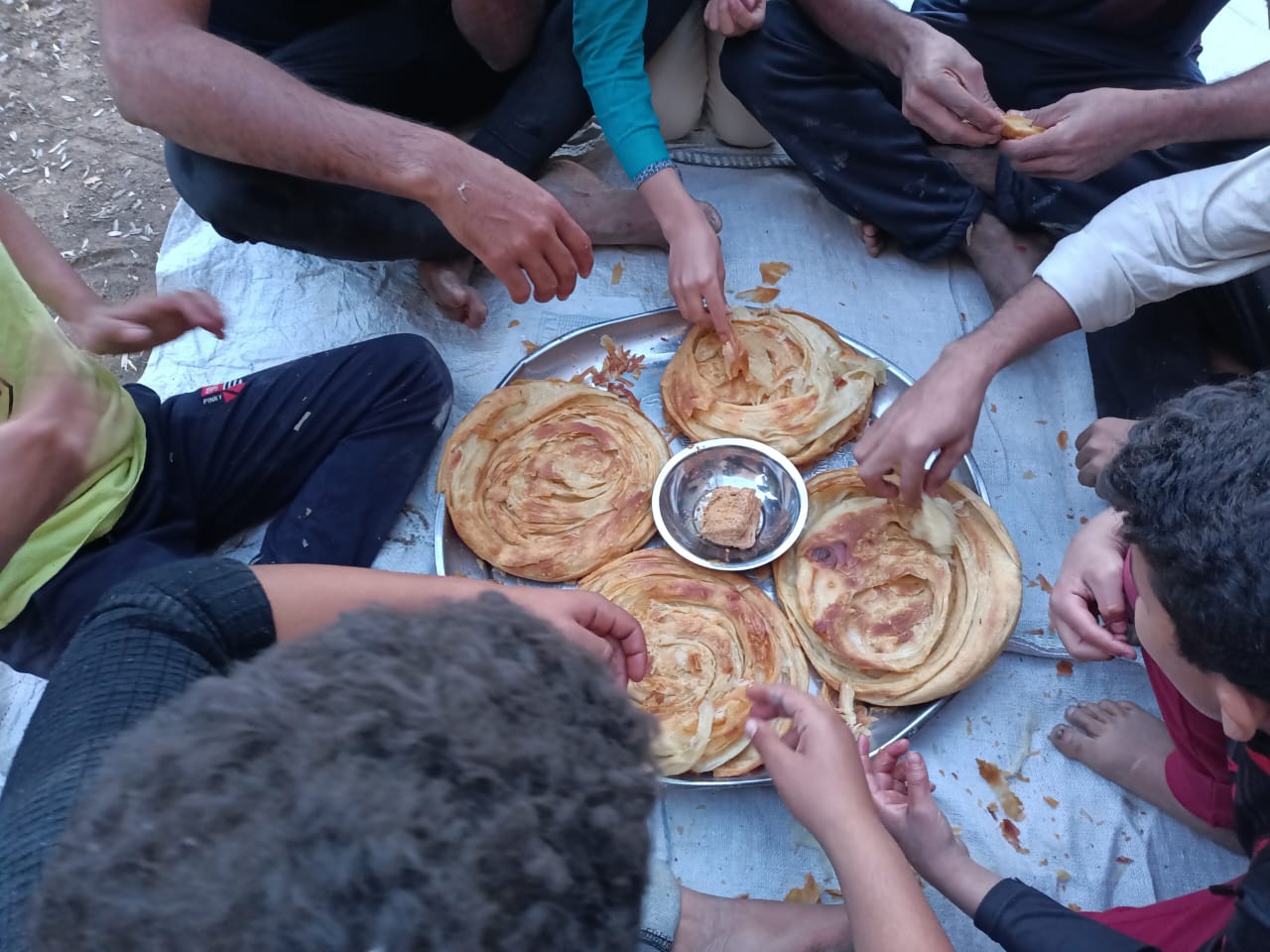
    85bf3bf8 d4a5 43bc 8ff0 1e27e430a050
    Wheat Harvest and Feteer Meshaltet – Photo: Jasmine Mehna

    Feteer Meshaltet and the Harvest

    Hassan Abdullah continues his narrative: “In our homes, the harvest scene is incomplete without welcoming the wheat with great celebration, as the season turns into a warm family festival. Once the “Diraas” (threshing) of the wheat concludes, my wife prepares “Feteer Meshaltet” (flaky, layered pastry) as a breakfast for the workers, amidst the laughter of the children and the joy of the “Khair” entering the home.”

    He adds: “The Feteer Meshaltet emerges from the a traditional mud oven, and the workers sit to share it happily, in a scene where the daily bread mingles with a laugh from the heart and deep satisfaction. We consider Feteer Meshaltet a symbol of joy and “Karam” (generosity), born of the blessing of the wheat and its arrival into the house.” According to a statement from the Assiut Governorate, the total area cultivated with wheat this year reached 204,933 acres, with expectations of increased yields compared to last year. This is particularly encouraged by the state’s decision to raise the price per “Ardeb” (a traditional unit of volume) to 2,500 pounds for the highest purity grade, with payments disbursed within 48 hours of delivery a move reflecting the state’s drive to incentivize farmers and bolster productivity.

    agriculture Assiut Egyptian farmers harvest traditions wheat
    Share. Facebook Twitter Pinterest LinkedIn Tumblr Email
    Previous ArticleArchitects of Identity: Aswan Women’s Film Festival Honors the Matriarchs of Cinema and Style
    Next Article Upon the Crest of the Sea: The Calligraphers Who Paint Dreams and Lineage onto the Hull
    Jasmine Mehna

    Related Posts

    The Sanctuary of Saint Bishoy: A Living Ledger of Egyptian Monasticism

    2026-05-13

    Shadows Over the Nile: Concrete Construction Spark Criticism Beneath the Temple of Kalabsha

    2026-05-13

    The Last Cobblers of Luxor: A Craft Contesting the Modern Tide

    2026-05-10

    Comments are closed.

    Recent Posts
    • The Woven Skeleton: The Palm Frond Artisans of Kafr Al-Battikh Fend Off a Plastic Tide
    • The Sanctuary of Saint Bishoy: A Living Ledger of Egyptian Monasticism
    • Shadows Over the Nile: Concrete Construction Spark Criticism Beneath the Temple of Kalabsha
    • The Damanhur Opera House: A Sovereign Union of Italian Elegance and Islamic Heritage
    • The Silent Outposts of Port Said: Ruins Beyond the Reach of Visitors
    Recent Comments
    • Binance美国注册 on An exhibition in Paris reimagines Cleopatra, far from Western narratives
    • binance "oppna konto on An exhibition in Paris reimagines Cleopatra, far from Western narratives
    • Binance账户创建 on Between popular religiosity and the benevolence of the Quran, how can beauty be reconnected with “Sayyida Zeinab”?
    • Binance创建账户 on Between popular religiosity and the benevolence of the Quran, how can beauty be reconnected with “Sayyida Zeinab”?
    • Skapa ett gratis konto on Central Ramses: Witness to Cairo’s transformations and the history of telecommunications in Egypt
    About Us
    About Us

    Your source for the lifestyle news. This demo is crafted specifically to exhibit the use of the theme as a lifestyle site. Visit our main page for more demos.

    We're accepting new partnerships right now.

    Email Us: info@example.com
    Contact: +1-320-0123-451

    Facebook X (Twitter) Pinterest YouTube WhatsApp
    Our Picks

    The Woven Skeleton: The Palm Frond Artisans of Kafr Al-Battikh Fend Off a Plastic Tide

    2026-05-14

    The Sanctuary of Saint Bishoy: A Living Ledger of Egyptian Monasticism

    2026-05-13

    Shadows Over the Nile: Concrete Construction Spark Criticism Beneath the Temple of Kalabsha

    2026-05-13
    Most Popular

    Shadows Over the Nile: Concrete Construction Spark Criticism Beneath the Temple of Kalabsha

    2026-05-135 Views

    The Sanctuary of Saint Bishoy: A Living Ledger of Egyptian Monasticism

    2026-05-132 Views

    Scientific trip to explore Upper Egypt temples

    2026-03-062 Views
    Demo
    Latest Posts

    The Woven Skeleton: The Palm Frond Artisans of Kafr Al-Battikh Fend Off a Plastic Tide

    2026-05-140 Views

    The Sanctuary of Saint Bishoy: A Living Ledger of Egyptian Monasticism

    2026-05-132 Views

    Shadows Over the Nile: Concrete Construction Spark Criticism Beneath the Temple of Kalabsha

    2026-05-135 Views

    The Damanhur Opera House: A Sovereign Union of Italian Elegance and Islamic Heritage

    2026-05-111 Views
    Stay In Touch
    • Facebook
    • Twitter
    • Pinterest
    • Instagram
    • YouTube
    • Vimeo
    Don't Miss

    Shadows Over the Nile: Concrete Construction Spark Criticism Beneath the Temple of Kalabsha

    By Bab Masr2026-05-13

    A controversy erupts in Aswan as new concrete structures at the Temple of Kalabsha spark…

    The Sanctuary of Saint Bishoy: A Living Ledger of Egyptian Monasticism

    2026-05-13

    Scientific trip to explore Upper Egypt temples

    2026-03-06

    Subscribe to Updates

    Get the latest creative news from SmartMag about art & design.

    Demo
    Demo
    Latest Posts

    The Woven Skeleton: The Palm Frond Artisans of Kafr Al-Battikh Fend Off a Plastic Tide

    2026-05-140 Views

    The Sanctuary of Saint Bishoy: A Living Ledger of Egyptian Monasticism

    2026-05-132 Views

    Shadows Over the Nile: Concrete Construction Spark Criticism Beneath the Temple of Kalabsha

    2026-05-135 Views

    The Damanhur Opera House: A Sovereign Union of Italian Elegance and Islamic Heritage

    2026-05-111 Views
    Stay In Touch
    • Facebook
    • Twitter
    • Pinterest
    • Instagram
    • YouTube
    • Vimeo
    Don't Miss

    Shadows Over the Nile: Concrete Construction Spark Criticism Beneath the Temple of Kalabsha

    By Bab Masr2026-05-13

    A controversy erupts in Aswan as new concrete structures at the Temple of Kalabsha spark…

    The Sanctuary of Saint Bishoy: A Living Ledger of Egyptian Monasticism

    2026-05-13

    Scientific trip to explore Upper Egypt temples

    2026-03-06

    Subscribe to Updates

    Get the latest creative news from SmartMag about art & design.

    Demo
    About Us
    About Us

    Your source for the lifestyle news. This demo is crafted specifically to exhibit the use of the theme as a lifestyle site. Visit our main page for more demos.

    We're accepting new partnerships right now.

    Email Us: info@example.com
    Contact: +1-320-0123-451

    Facebook X (Twitter) Pinterest YouTube WhatsApp
    Our Picks

    The Woven Skeleton: The Palm Frond Artisans of Kafr Al-Battikh Fend Off a Plastic Tide

    2026-05-14

    The Sanctuary of Saint Bishoy: A Living Ledger of Egyptian Monasticism

    2026-05-13

    Shadows Over the Nile: Concrete Construction Spark Criticism Beneath the Temple of Kalabsha

    2026-05-13
    Most Popular

    Shadows Over the Nile: Concrete Construction Spark Criticism Beneath the Temple of Kalabsha

    2026-05-135 Views

    The Sanctuary of Saint Bishoy: A Living Ledger of Egyptian Monasticism

    2026-05-132 Views

    Scientific trip to explore Upper Egypt temples

    2026-03-062 Views
    © 2026 ThemeSphere. Designed by ThemeSphere.

    Type above and press Enter to search. Press Esc to cancel.