



Close Menu
باب مصرباب مصر

    Subscribe to Updates

    Get the latest creative news from FooBar about art, design and business.

    What's Hot

    The Woven Skeleton: The Palm Frond Artisans of Kafr Al-Battikh Fend Off a Plastic Tide

    2026-05-14

    The Sanctuary of Saint Bishoy: A Living Ledger of Egyptian Monasticism

    2026-05-13

    Shadows Over the Nile: Concrete Construction Spark Criticism Beneath the Temple of Kalabsha

    2026-05-13
    Facebook X (Twitter) Instagram
    Facebook X (Twitter) Instagram YouTube LinkedIn
    باب مصرباب مصر
    Contact US
    باب مصرباب مصر
    Home»Upper Egypt»Golden Strands and Family Hands: A Qena Tradition That Binds Generations
    Upper Egypt

    Golden Strands and Family Hands: A Qena Tradition That Binds Generations

    Moussa AdelBy Moussa Adel2026-03-18Updated:2026-05-20No Comments5 Mins Read0 Views
    Facebook Twitter Pinterest LinkedIn Tumblr Email
    Share
    Facebook Twitter LinkedIn Pinterest WhatsApp Email

     In Qena governorate, families mark the end of Ramadan with a unique tradition: gathering to make baladi kunafa by hand over traditional clay ovens. Grandmothers teach granddaughters, neighbours share the workload, and the golden strands become gifts for everyone.

    As the final days of Ramadan approach, households across Egypt begin preparing for Eid. Cookies are baked, sweets are arranged on platters, and gifts of food are exchanged between relatives and neighbours.

    But in Qena governorate, one tradition stands apart. Here, families mark the end of the holy month with a ritual that has been passed down through generations: the communal making of baladi kunafa over traditional clay ovens. Grandmothers and granddaughters gather. Recipes and skills are transmitted from the old to the young. And when the work is done, the golden strands are distributed to everyone.

    Kunafa Over the Clay Oven

    “Bab Misr” visited a home where women and girls had gathered to make baladi kunafa over a kanoun, the traditional clay oven, sprinkling the batter onto an ancient clay saja griddle.

    Hannem Mahmoud Moussa, 70, remembers how it was done before the High Dam was built. “We would gather with our mothers and a group of women in a neighbor’s house. The kanoun would be outside, in an open space. One of us would knead the kunafa dough in a large clay pot, making a big batch to distribute to everyone.”

    “We gathered every day,” she continues. “We made a large quantity to give to the neighbors. We divided the tasks. One woman sprinkled the kunafa, another lit the fire beneath it, another brought the firewood, another kneaded. We kept going until the dough was finished. Then each woman took a kilo home with her.”

    In those days, she explains, kunafa was eaten simply with sugar at sunset, serving as the sweet to conclude the iftar meal.
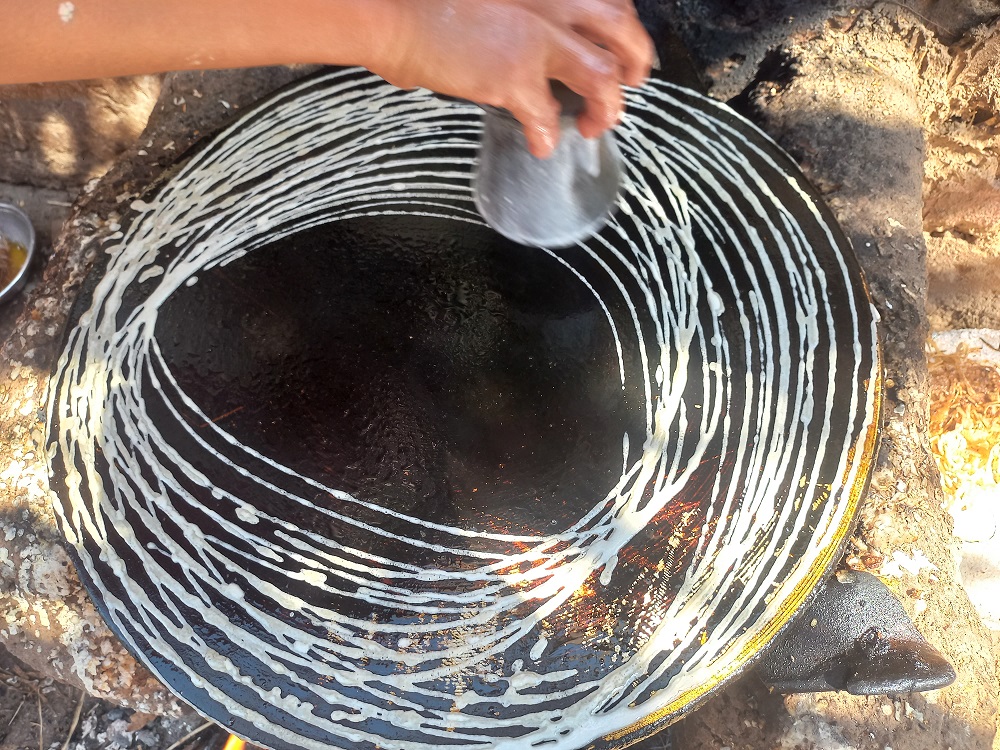
    Traditional baladi kunafa. Photo credit: Asmaa El-Sharkawy

    Preserving Family Heritage

    Zenab Ali, 76, learned to make baladi kunafa with her mother-in-law. They would distribute it to her siblings, her husband’s siblings, and close neighbors.

    “We make it because it is a traditional dish inherited from our ancestors,” she says. “My mother-in-law learned it from her mother and grandmother. I passed it to my daughters and my daughter-in-law. We still make it the old way, on the kanoun, sprinkling it with the old kozz (a perforated cup for drizzling) and using the old clay pot.”

    Zenab explains how things have changed. “In the past, we made it and ate it with sugar and clarified butter. Now, we make it and store it in paper, then in the refrigerator. It lasts about half a month. Before eating, we brown it on the gas stove with clarified butter, then pour local milk sweetened with sugar over it and eat it for suhur.”

    Some women, she notes, use a different method: mixing flour, water, and salt, letting the dough dry slightly, then cooking it over steam and adding sugar to eat at sunset.
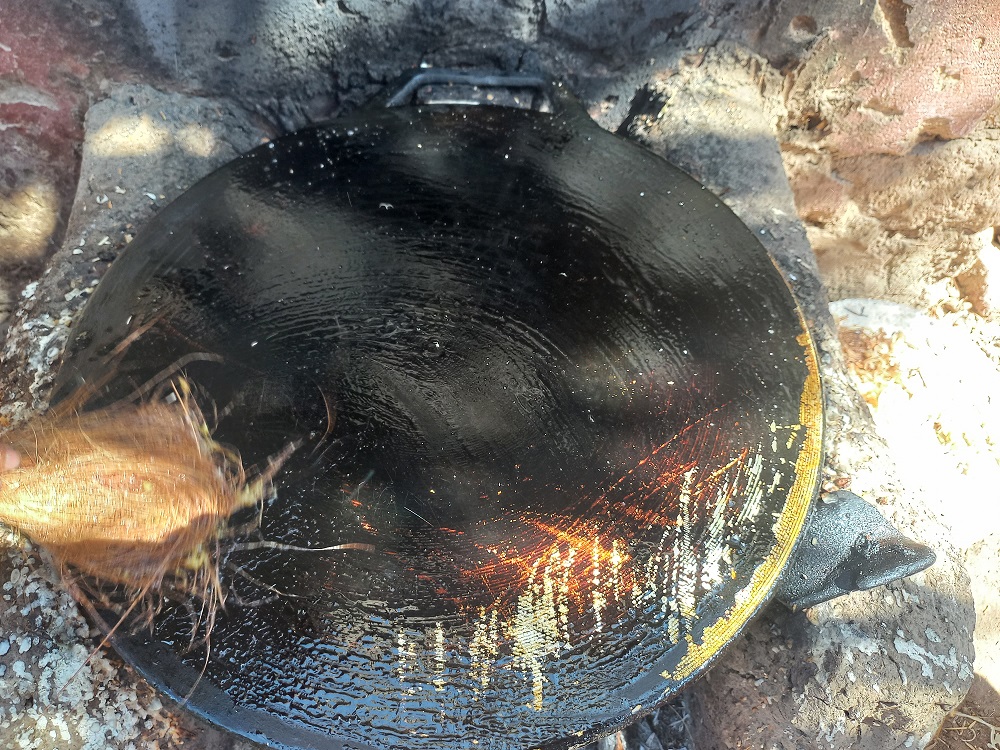
    Traditional baladi kunafa. Photo credit: Asmaa El-Sharkawy

    Kunafa and Keeping Tradition Alive

    Doaa Mohamed Ahmed, a homemaker, inherited the craft from her mother, who learned it from previous generations.

    “I inherited the making of baladi kunafa the traditional way, over a simple, low flame, using the old oven or the clay kanoun,” she says.

    Her family begins preparing early. “From the start of Ramadan, we get ready to build a small kanoun on the roof to make kunafa. We make one batch at the beginning of the month and another near the end. We divide the tasks among the women to make a large quantity to distribute to family members and neighbors.”

    For Doaa, the day of making kunafa is special. “We make it because we inherited it from our grandparents, then from my mother. We keep this heritage alive, along with our Ramadan customs. And besides all that, it tastes beautiful. It fills your stomach at suhur.”
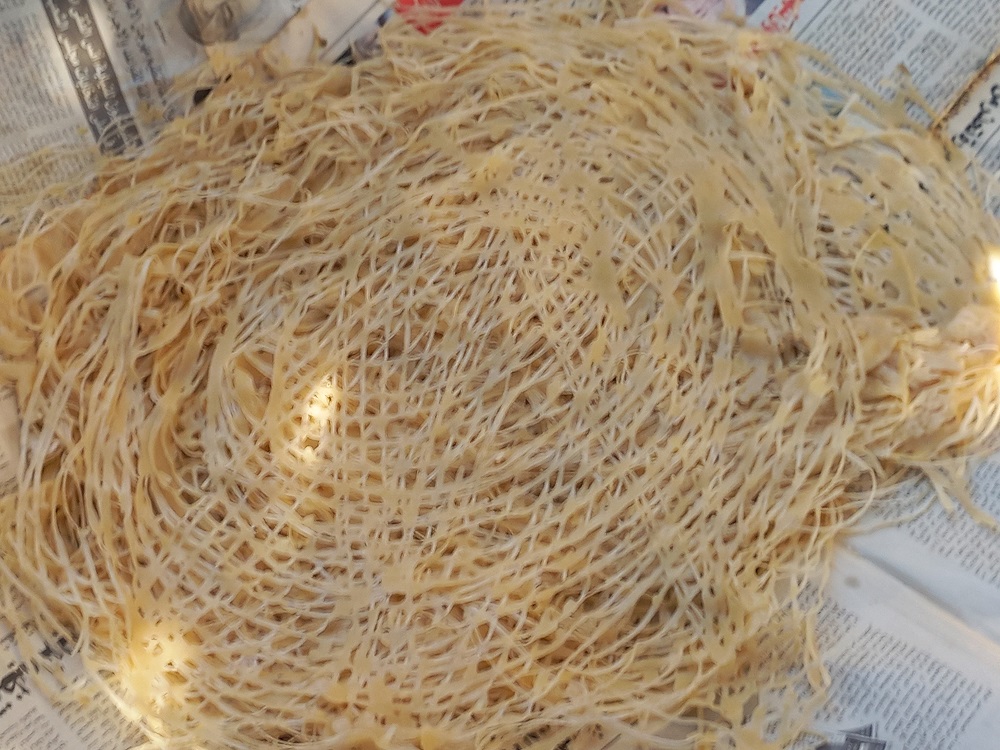
     Traditional baladi kunafa. Photo credit: Asmaa El-Sharkawy

    How It’s Made

    Doaa describes the process step by step.

    “We put water, a pinch of salt, then a mix of fine flour and local flour. We knead until the dough becomes liquid. Then we dip a piece of palm fiber in oil and egg and wipe the saja with it, lighting the fire beneath. We start sprinkling the kunafa through an open cup that works like a nozzle. We wait until it cooks at a low temperature, then take it out onto a large plate. We keep going until the dough is finished. Then we distribute it to everyone to eat at suhur with sugar and a little milk.”

    Her sister, Nagah Mohamed Ahmed, chimes in. “We gather at the family home and make kunafa twice during Ramadan. Once at the beginning, once near the end. We inherited the tradition of making kunafa and the family gathering from our grandmothers. That is why we keep both the craft and the gathering alive during this blessed month.”

    “We only make it during Ramadan,” she concludes, “because it is tied to this month. Kunafa is beautiful food, clean food, and it tastes better when made at home.”

    Baladi kanafa recipe clay oven cooking Egypt Egyptian Eid preparations Egyptian Ramadan traditions kanoun oven Qena Governorate cuisine saja griddle traditional kanafa making
    Share. Facebook Twitter Pinterest LinkedIn Tumblr Email
    Previous ArticleThe Statue That Crossed Continents: A War Memorial’s Journey From Egypt to Australia
    Next Article Where the Whole Neighborhood Bakes: Minya’s Communal Eid Cookie Tradition
    Moussa Adel

    Related Posts

    The Sanctuary of Saint Bishoy: A Living Ledger of Egyptian Monasticism

    2026-05-13

    Shadows Over the Nile: Concrete Construction Spark Criticism Beneath the Temple of Kalabsha

    2026-05-13

    The Last Cobblers of Luxor: A Craft Contesting the Modern Tide

    2026-05-10

    Comments are closed.

    Recent Posts
    • The Woven Skeleton: The Palm Frond Artisans of Kafr Al-Battikh Fend Off a Plastic Tide
    • The Sanctuary of Saint Bishoy: A Living Ledger of Egyptian Monasticism
    • Shadows Over the Nile: Concrete Construction Spark Criticism Beneath the Temple of Kalabsha
    • The Damanhur Opera House: A Sovereign Union of Italian Elegance and Islamic Heritage
    • The Silent Outposts of Port Said: Ruins Beyond the Reach of Visitors
    Recent Comments
    • Binance美国注册 on An exhibition in Paris reimagines Cleopatra, far from Western narratives
    • binance "oppna konto on An exhibition in Paris reimagines Cleopatra, far from Western narratives
    • código de referencia de Binance on Art exhibition documents the first Egyptian Scout postage stamp at the National Museum of Civilization
    • Binance账户创建 on Between popular religiosity and the benevolence of the Quran, how can beauty be reconnected with “Sayyida Zeinab”?
    • phoenix game on Theater never dies… Mansoura saves its heritage and restores it as an opera house
    About Us
    About Us

    Your source for the lifestyle news. This demo is crafted specifically to exhibit the use of the theme as a lifestyle site. Visit our main page for more demos.

    We're accepting new partnerships right now.

    Email Us: info@example.com
    Contact: +1-320-0123-451

    Facebook X (Twitter) Pinterest YouTube WhatsApp
    Our Picks

    The Woven Skeleton: The Palm Frond Artisans of Kafr Al-Battikh Fend Off a Plastic Tide

    2026-05-14

    The Sanctuary of Saint Bishoy: A Living Ledger of Egyptian Monasticism

    2026-05-13

    Shadows Over the Nile: Concrete Construction Spark Criticism Beneath the Temple of Kalabsha

    2026-05-13
    Most Popular

    Shadows Over the Nile: Concrete Construction Spark Criticism Beneath the Temple of Kalabsha

    2026-05-135 Views

    The Sanctuary of Saint Bishoy: A Living Ledger of Egyptian Monasticism

    2026-05-132 Views

    The Healing Arteries of Dakhla: Harnessing the Geothermal Riches of the New Valley

    2026-05-062 Views
    Demo
    Latest Posts

    The Woven Skeleton: The Palm Frond Artisans of Kafr Al-Battikh Fend Off a Plastic Tide

    2026-05-140 Views

    The Sanctuary of Saint Bishoy: A Living Ledger of Egyptian Monasticism

    2026-05-132 Views

    Shadows Over the Nile: Concrete Construction Spark Criticism Beneath the Temple of Kalabsha

    2026-05-135 Views

    The Damanhur Opera House: A Sovereign Union of Italian Elegance and Islamic Heritage

    2026-05-111 Views
    Stay In Touch
    • Facebook
    • Twitter
    • Pinterest
    • Instagram
    • YouTube
    • Vimeo
    Don't Miss

    Shadows Over the Nile: Concrete Construction Spark Criticism Beneath the Temple of Kalabsha

    By Bab Masr2026-05-13

    A controversy erupts in Aswan as new concrete structures at the Temple of Kalabsha spark…

    The Sanctuary of Saint Bishoy: A Living Ledger of Egyptian Monasticism

    2026-05-13

    The Healing Arteries of Dakhla: Harnessing the Geothermal Riches of the New Valley

    2026-05-06

    Subscribe to Updates

    Get the latest creative news from SmartMag about art & design.

    Demo
    Demo
    Latest Posts

    The Woven Skeleton: The Palm Frond Artisans of Kafr Al-Battikh Fend Off a Plastic Tide

    2026-05-140 Views

    The Sanctuary of Saint Bishoy: A Living Ledger of Egyptian Monasticism

    2026-05-132 Views

    Shadows Over the Nile: Concrete Construction Spark Criticism Beneath the Temple of Kalabsha

    2026-05-135 Views

    The Damanhur Opera House: A Sovereign Union of Italian Elegance and Islamic Heritage

    2026-05-111 Views
    Stay In Touch
    • Facebook
    • Twitter
    • Pinterest
    • Instagram
    • YouTube
    • Vimeo
    Don't Miss

    Shadows Over the Nile: Concrete Construction Spark Criticism Beneath the Temple of Kalabsha

    By Bab Masr2026-05-13

    A controversy erupts in Aswan as new concrete structures at the Temple of Kalabsha spark…

    The Sanctuary of Saint Bishoy: A Living Ledger of Egyptian Monasticism

    2026-05-13

    The Healing Arteries of Dakhla: Harnessing the Geothermal Riches of the New Valley

    2026-05-06

    Subscribe to Updates

    Get the latest creative news from SmartMag about art & design.

    Demo
    About Us
    About Us

    Your source for the lifestyle news. This demo is crafted specifically to exhibit the use of the theme as a lifestyle site. Visit our main page for more demos.

    We're accepting new partnerships right now.

    Email Us: info@example.com
    Contact: +1-320-0123-451

    Facebook X (Twitter) Pinterest YouTube WhatsApp
    Our Picks

    The Woven Skeleton: The Palm Frond Artisans of Kafr Al-Battikh Fend Off a Plastic Tide

    2026-05-14

    The Sanctuary of Saint Bishoy: A Living Ledger of Egyptian Monasticism

    2026-05-13

    Shadows Over the Nile: Concrete Construction Spark Criticism Beneath the Temple of Kalabsha

    2026-05-13
    Most Popular

    Shadows Over the Nile: Concrete Construction Spark Criticism Beneath the Temple of Kalabsha

    2026-05-135 Views

    The Sanctuary of Saint Bishoy: A Living Ledger of Egyptian Monasticism

    2026-05-132 Views

    The Healing Arteries of Dakhla: Harnessing the Geothermal Riches of the New Valley

    2026-05-062 Views
    © 2026 ThemeSphere. Designed by ThemeSphere.

    Type above and press Enter to search. Press Esc to cancel.