



Close Menu
باب مصرباب مصر

    Subscribe to Updates

    Get the latest creative news from FooBar about art, design and business.

    What's Hot

    The Sanctuary of Saint Bishoy: A Living Ledger of Egyptian Monasticism

    2026-05-13

    Shadows Over the Nile: Concrete Construction Spark Criticism Beneath the Temple of Kalabsha

    2026-05-13

    The Last Cobblers of Luxor: A Craft Contesting the Modern Tide

    2026-05-10
    Facebook X (Twitter) Instagram
    Facebook X (Twitter) Instagram YouTube LinkedIn
    باب مصرباب مصر
    Contact US
    باب مصرباب مصر
    Home»Upper Egypt»The Sanctuary of Saint Bishoy: A Living Ledger of Egyptian Monasticism
    Upper Egypt

    The Sanctuary of Saint Bishoy: A Living Ledger of Egyptian Monasticism

    Bab MasrBy Bab Masr2026-05-13Updated:2026-05-20No Comments6 Mins Read1 Views
    Facebook Twitter Pinterest LinkedIn Tumblr Email
    1492675832 390 1345584 1 scaled
    1492675832 390 1345584 1 scaled
    Share
    Facebook Twitter LinkedIn Pinterest WhatsApp Email

    The hallowed silence of Wadi El Natrun’s Monastery of Saint Bishoy, a spiritual fortress of Egyptian monasticism housing ancient relics, the papal legacy of Pope Shenouda III, and centuries of Coptic architectural heritage.

    By Mahmoud Dowair

    Deep within the Western Desert, approximately 120 kilometers from the pulse of Cairo, the Wadi El Natrun depression cradles an ancient solitude. This desert basin remains one of Egypt’s most storied archaeological and religious landscapes, home to monasteries that stand among the oldest and most venerable institutions in Christian history.

    For centuries, this valley has borne witness to the rigors of Egyptian monasticism, defined by an unwavering spirit of asceticism, seclusion, and interiority. Here, the sanctity of the site dissolves into the desert sands, lending this historic valley its singular, hallowed character.

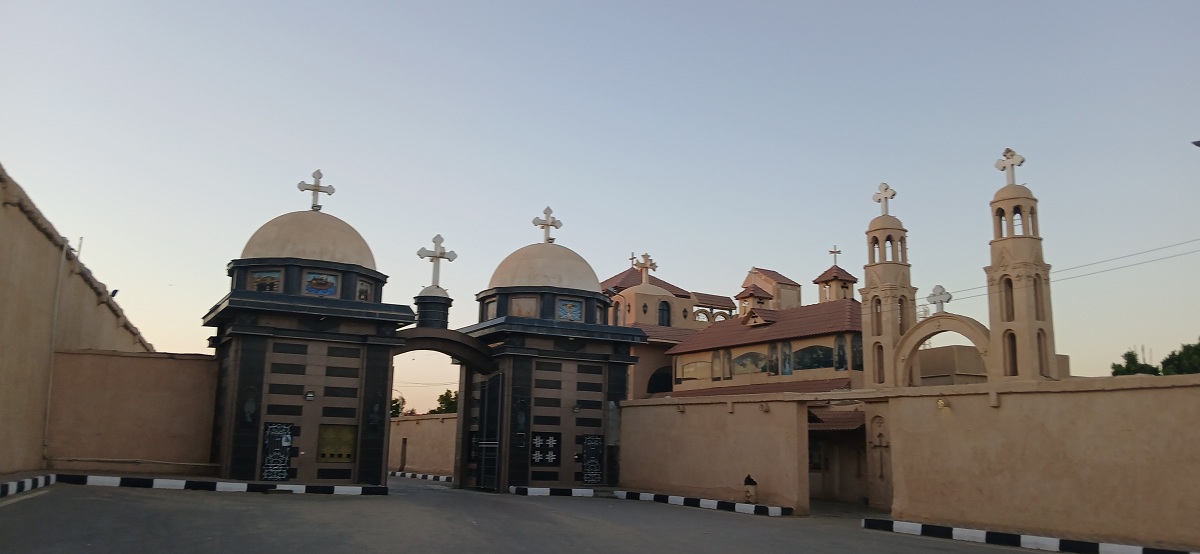
    The Monastery of Saint Bishoy stands at the zenith of these retreats, anchored by its profound spiritual and heritage status. Its significance reached a new contemporary height after Pope Shenouda III chose it as his final resting place before his passing in 2012. Today, the monastery remains a primary pilgrimage site, drawing visitors from across Egypt and the globe.

    A Valley of Many Names and Ancient Salts

    Dr. Sylvana George Attia, a specialist in Coptic history, notes that Wadi El Natrun traces its origins back to two millennia before the common era. Ancient Egyptians erected temples and military outposts here to secure the western frontiers, harvesting natron salt for mummification, dyes, and chemical arts.

    The valley has been known by many monikers: the Valley of Salt, the Holy Scetis (a center of worship), the Wilderness of Shiheet (the measure of hearts), and the Valley of Habib. Its identity as a “valley” stems from its natural low-lying topography, while “Valley of Salt” highlights its richness in natron a substance distinct from common table salt. In Coptic, “Shiheet” translates to “The Measure of Hearts,” suggesting that those who dwelt here in devotion could weigh their own souls, confronting their progress toward a life of virtue and perfection. “Scetis” denotes a “Center of Worship” or “Place of Asceticism,” which, according to historical estimates, housed more than seventy thousand monks by the mid-seventh century.

    Dr. Attia observes that the monastic population today numbers approximately eight hundred. Meanwhile, the name “Wadi Habib” derives from a Coptic root: Ha (many) and Beeb (caves), signifying the “Valley of Many Caves.”
    ٢٠٢٦٠٥٠٥ ١٩٣٢٠٧
    ٢٠٢٦٠٥٠٥ ١٩٣٢١٢
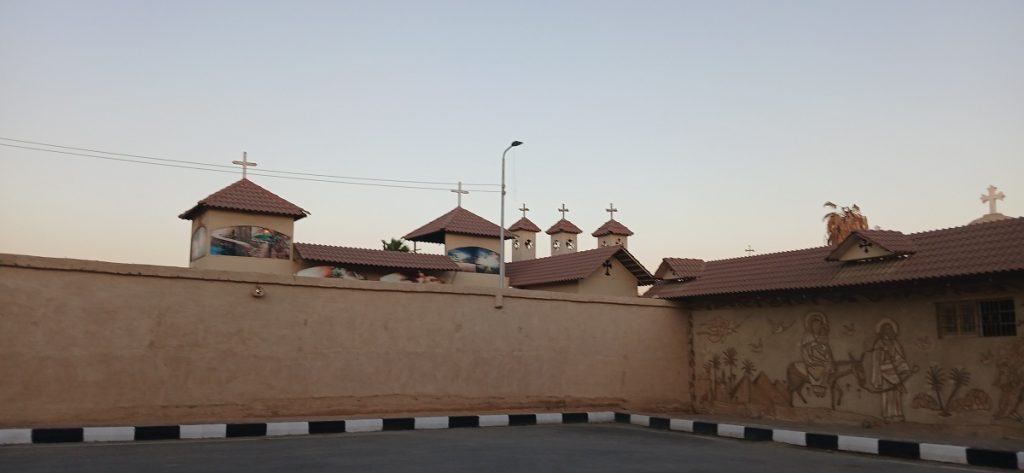
    The Monastery of Saint Bishoy in Wadi El Natrun – Photo: Mahmoud Dwair

    The Great Monastic Community and the Papal Legacy

    Fr. Ezra El-Anba Bishoy, the monastery’s director of visits, explains that Bishoy is a Coptic term meaning “The Exalted” or “The Elevated.” Saint Bishoy was born in 320 AD in the village of Shantan al-Hajar in Menofia, one of seven siblings. At twenty, in the year 340 AD, he embraced the monastic life and retreated to the Wadi El Natrun desert to found this sanctuary.

    Fr. Ezra outlines four pillars of the monastery’s global importance: it hosts the largest monastic community, currently numbering 220 monks; it serves as a Papal Residence the third for the Coptic Pope after Abbaseya and Alexandria; and it is the alma mater of three patriarchs, including Pope Gabriel VIII (97th), Pope Macarius III (114th), and the incumbent Pope Tawadros II (118th), who ascended the Throne of Saint Mark in November 2012. Finally, it houses the shrine of Pope Shenouda III, a figure of immense global renown.

    Architectural Marvels and the Martyrs’ Well

    Spanning roughly four acres, the monastery complex features structures of exceptional architectural pedigree. Among them is the “Well of the Martyrs.” Originally dug by Saint Bishoy’s disciples for drinking water, the well became a site of tragic consecration following Berber raids. During the third attack in 444 AD, forty-nine monks were martyred at the nearby Monastery of Saint Macarius; the raiders reportedly washed their blood-stained swords in this well upon their return. From that day forward, it was christened the Well of the Martyrs.

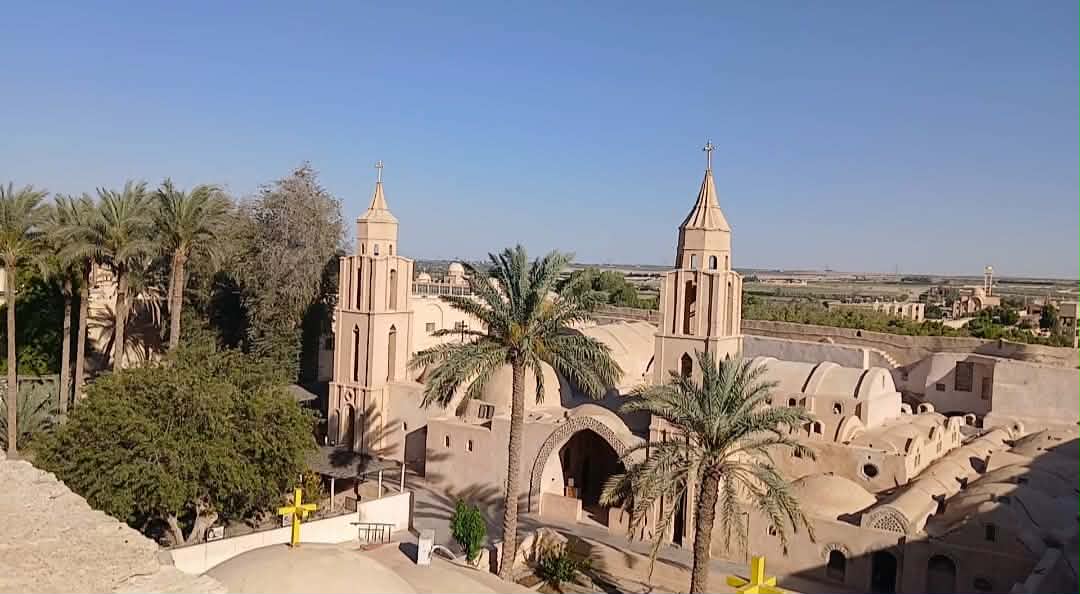
    The Church of Saint Bishoy, which preserves the saint’s full relics, includes several annexes: the Church of Saint Benjamin II and the Church of Abasikhiron, the latter housing a reliquary of the saint’s remains.

    The church also features an ancient iconostasis (a wall of icons and religious paintings) dating to the 15th century. Fr. Ezra points out that while much of the infrastructure dates to the post-9th-century era due to Berber raids that leveled earlier structures rare survivors remain, such as the main sanctuary door which dates back to the 7th century.
    662734131 2597603310655291 7022583610002411209 n
    The Monastery of Saint Bishoy in Wadi El Natrun – Photo: Mahmoud Dwair

    Resilience Against the Elements: The Fortress and the Shrine

    Regarding the church’s ceiling, Fr. Ezra recounts how the original timber roof succumbed to the ravages of termites, leading to a partial collapse. During his reign (1327–1339 AD), Pope Benjamin II (the 82nd Pope) commissioned a limestone replacement. This ceiling is a tapestry of cultural synthesis, featuring the Coptic Cross, the Star of David, and the eight-pointed star characteristic of Islamic art.

    The church also guards an icon of the Virgin Mary from the 13th or 14th century, flanked by a small 9th-century library. However, the monastery’s most imposing feature is the Keep (a defensive fortress tower) dating to 475 AD. Commissioned by the Roman Emperor Zeno for all such monasteries, these keeps were designed to shield monks from nomadic incursions.

    The three-story fortress is a marvel of self-sufficiency: the first floor contains a water well, a granary, and qallali (monastic cells) that is, residence and rest quarters for the monks while the second floor houses a chapel. The third floor is dedicated to a church named after Archangel Michael, reflecting the belief that the Archangel guards the roof of the stronghold.

    Discussing the shrine of Pope Shenouda III, Fr. Ezra notes that the late Pope, who passed in 2012, specifically requested burial at the Monastery of Saint Bishoy. The shrine displays his body alongside a collection of personal effects: vestments, manuscripts, and the pens he used to write. A dedicated gallery also showcases photographs of the Pope with prominent religious, political, and intellectual figures.

    A Call for Global Heritage Status

    Dr. Shahd Al-Bayaa, Director of Archaeological Site Development in Wadi El Natrun, describes the monastery as a masterpiece of the Basilican style, characterized by its vaulted ceilings and an encircling wall standing 12 to 13 meters high.

    She highlights the distinct architectural identity of Wadi El Natrun compared to other Egyptian provinces. While churches in Upper Egypt or near the Red Sea often utilize a multitude of domessometimes up to 22 in a single structure to combat extreme heat the sanctuaries here rely on the vaulting system typical of the Basilican tradition.

    Given this unique architectural harmony and historical weight, Al-Bayaa advocates for the inclusion of Wadi El Natrun and its entire monastic landscape on the UNESCO World Heritage list, honoring a design language that remains peerless throughout Egypt.

    coptic desert history monastery monasticism
    Share. Facebook Twitter Pinterest LinkedIn Tumblr Email
    Previous ArticleShadows Over the Nile: Concrete Construction Spark Criticism Beneath the Temple of Kalabsha
    Bab Masr

    Related Posts

    Shadows Over the Nile: Concrete Construction Spark Criticism Beneath the Temple of Kalabsha

    2026-05-13

    The Last Cobblers of Luxor: A Craft Contesting the Modern Tide

    2026-05-10

    The Preservation Paradox: Why Humanity, Not Time, Is the Greatest Threat to Heritage

    2026-05-06

    Comments are closed.

    Recent Posts
    • The Sanctuary of Saint Bishoy: A Living Ledger of Egyptian Monasticism
    • Shadows Over the Nile: Concrete Construction Spark Criticism Beneath the Temple of Kalabsha
    • The Last Cobblers of Luxor: A Craft Contesting the Modern Tide
    • The Silent Sentinels of the Shore: How the Red Sea’s Mangroves Defend the Coast and Cradle Life
    • The Healing Arteries of Dakhla: Harnessing the Geothermal Riches of the New Valley
    Recent Comments
    • Binance美国注册 on An exhibition in Paris reimagines Cleopatra, far from Western narratives
    • binance "oppna konto on An exhibition in Paris reimagines Cleopatra, far from Western narratives
    • Binance账户创建 on Between popular religiosity and the benevolence of the Quran, how can beauty be reconnected with “Sayyida Zeinab”?
    • Binance创建账户 on Between popular religiosity and the benevolence of the Quran, how can beauty be reconnected with “Sayyida Zeinab”?
    • Skapa ett gratis konto on Central Ramses: Witness to Cairo’s transformations and the history of telecommunications in Egypt
    About Us
    About Us

    Your source for the lifestyle news. This demo is crafted specifically to exhibit the use of the theme as a lifestyle site. Visit our main page for more demos.

    We're accepting new partnerships right now.

    Email Us: info@example.com
    Contact: +1-320-0123-451

    Facebook X (Twitter) Pinterest YouTube WhatsApp
    Our Picks

    The Sanctuary of Saint Bishoy: A Living Ledger of Egyptian Monasticism

    2026-05-13

    Shadows Over the Nile: Concrete Construction Spark Criticism Beneath the Temple of Kalabsha

    2026-05-13

    The Last Cobblers of Luxor: A Craft Contesting the Modern Tide

    2026-05-10
    Most Popular

    Shadows Over the Nile: Concrete Construction Spark Criticism Beneath the Temple of Kalabsha

    2026-05-135 Views

    Scientific trip to explore Upper Egypt temples

    2026-03-062 Views

    Arab Umm Kulthum vs Egyptian Abdel Wahab: Two Visions of Cultural Identity on Screen

    2026-01-142 Views
    Demo
    Latest Posts

    The Sanctuary of Saint Bishoy: A Living Ledger of Egyptian Monasticism

    2026-05-131 Views

    Shadows Over the Nile: Concrete Construction Spark Criticism Beneath the Temple of Kalabsha

    2026-05-135 Views

    The Last Cobblers of Luxor: A Craft Contesting the Modern Tide

    2026-05-100 Views

    The Silent Sentinels of the Shore: How the Red Sea’s Mangroves Defend the Coast and Cradle Life

    2026-05-100 Views
    Stay In Touch
    • Facebook
    • Twitter
    • Pinterest
    • Instagram
    • YouTube
    • Vimeo
    Don't Miss

    Shadows Over the Nile: Concrete Construction Spark Criticism Beneath the Temple of Kalabsha

    By Bab Masr2026-05-13

    A controversy erupts in Aswan as new concrete structures at the Temple of Kalabsha spark…

    Scientific trip to explore Upper Egypt temples

    2026-03-06

    Arab Umm Kulthum vs Egyptian Abdel Wahab: Two Visions of Cultural Identity on Screen

    2026-01-14

    Subscribe to Updates

    Get the latest creative news from SmartMag about art & design.

    Demo
    Demo
    Latest Posts

    The Sanctuary of Saint Bishoy: A Living Ledger of Egyptian Monasticism

    2026-05-131 Views

    Shadows Over the Nile: Concrete Construction Spark Criticism Beneath the Temple of Kalabsha

    2026-05-135 Views

    The Last Cobblers of Luxor: A Craft Contesting the Modern Tide

    2026-05-100 Views

    The Silent Sentinels of the Shore: How the Red Sea’s Mangroves Defend the Coast and Cradle Life

    2026-05-100 Views
    Stay In Touch
    • Facebook
    • Twitter
    • Pinterest
    • Instagram
    • YouTube
    • Vimeo
    Don't Miss

    Shadows Over the Nile: Concrete Construction Spark Criticism Beneath the Temple of Kalabsha

    By Bab Masr2026-05-13

    A controversy erupts in Aswan as new concrete structures at the Temple of Kalabsha spark…

    Scientific trip to explore Upper Egypt temples

    2026-03-06

    Arab Umm Kulthum vs Egyptian Abdel Wahab: Two Visions of Cultural Identity on Screen

    2026-01-14

    Subscribe to Updates

    Get the latest creative news from SmartMag about art & design.

    Demo
    About Us
    About Us

    Your source for the lifestyle news. This demo is crafted specifically to exhibit the use of the theme as a lifestyle site. Visit our main page for more demos.

    We're accepting new partnerships right now.

    Email Us: info@example.com
    Contact: +1-320-0123-451

    Facebook X (Twitter) Pinterest YouTube WhatsApp
    Our Picks

    The Sanctuary of Saint Bishoy: A Living Ledger of Egyptian Monasticism

    2026-05-13

    Shadows Over the Nile: Concrete Construction Spark Criticism Beneath the Temple of Kalabsha

    2026-05-13

    The Last Cobblers of Luxor: A Craft Contesting the Modern Tide

    2026-05-10
    Most Popular

    Shadows Over the Nile: Concrete Construction Spark Criticism Beneath the Temple of Kalabsha

    2026-05-135 Views

    Scientific trip to explore Upper Egypt temples

    2026-03-062 Views

    Arab Umm Kulthum vs Egyptian Abdel Wahab: Two Visions of Cultural Identity on Screen

    2026-01-142 Views
    © 2026 ThemeSphere. Designed by ThemeSphere.

    Type above and press Enter to search. Press Esc to cancel.