



Close Menu
باب مصرباب مصر

    Subscribe to Updates

    Get the latest creative news from FooBar about art, design and business.

    What's Hot

    The Woven Skeleton: The Palm Frond Artisans of Kafr Al-Battikh Fend Off a Plastic Tide

    2026-05-14

    The Sanctuary of Saint Bishoy: A Living Ledger of Egyptian Monasticism

    2026-05-13

    Shadows Over the Nile: Concrete Construction Spark Criticism Beneath the Temple of Kalabsha

    2026-05-13
    Facebook X (Twitter) Instagram
    Facebook X (Twitter) Instagram YouTube LinkedIn
    باب مصرباب مصر
    Contact US
    باب مصرباب مصر
    Home»Upper Egypt»The Sentinel of Forgotten Memories: The Tale of Rajab Shimi, the Last Inhabitant of Old Qurna Marei
    Upper Egypt

    The Sentinel of Forgotten Memories: The Tale of Rajab Shimi, the Last Inhabitant of Old Qurna Marei

    Abo Elhasan Abd ElsattarBy Abo Elhasan Abd Elsattar2026-04-28Updated:2026-05-20No Comments6 Mins Read0 Views
    Facebook Twitter Pinterest LinkedIn Tumblr Email
    1492203155 140 63378 8
    1492203155 140 63378 8
    Share
    Facebook Twitter LinkedIn Pinterest WhatsApp Email

    In the shadow of the Theban Necropolis, Rajab Shimi remains the final sentinel of Old Qurna. This evocative feature explores a life anchored in ancestral caverns, the bitterness of bureaucratic displacement, and the lyrical preservation of a village that now exists only in the corridors of memory.

    Perched atop the Qurna mountain, nestled against the hallowed silence of ancient Pharaonic tombs, lives a man solitary in a village that no longer exists except in the corridors of memory. Rajab Jaber Talba Ali Shimi is the final permanent resident of Old Qurna Marei. Or, at least, that is how he introduces himself with a quiet dignity before unraveling a narrative that spans over a century, anchored in a single house he has never forsaken since his birth in 1967.

    More Than Mere Masonry

    “I am the only one who has remained here since the moment I was born,” Rajab says. “I have never left this house.” The structure, as he describes it, is not merely walls of tub laban (sun-dried mud brick), but rather geological strata of history. It was erected over ancient caverns inhabited by his ancestors centuries ago, when the Nile’s inundation would swallow the lowlands, driving the people to the mountain’s zenith in search of salvation. This was an era when antiquities were known in the local tongue as masakhit (ancient deformities), their historical gravity not yet anchored in the public consciousness.

    However, the tide that turned was not just the Nile’s, but humanity’s. In 1997, the state initiated a mass relocation project to move the villagers of Qurna to modern housing, an effort to safeguard the archaeological sites. Most families departed, but Rajab remained. It was not an act of defiance, but a bureaucratic erasure: his name was absent from the compensation ledgers.

    “They told me, ‘You have no record here.’ I tried every avenue, pleading with them to register my name, assuming it was a clerical oversight, but to no avail,” he recounts. His tone is hushed, devoid of outward rage, yet saturated with a long-steeping bitterness. Neither he nor his brothers received compensation, leaving him to linger in the ancestral home while his kin scattered between New Qurna and the surrounding districts.

    A House Breathless Within the Mountain

    The irony is that Rajab did not choose isolation; it was thrust upon him. “My brothers should have stayed with me, but the house cannot bear the weight of us all, so it is just my wife and I here now,” he explains. He gestures toward the formidable walls, half a meter thick, which grant the home a singular alchemy: it is a sanctuary of coolness in the summer and a cradle of warmth in winter. Inside the maghara (mountain cave), where the house extends deep into the mountain’s heart, the laws of thermodynamics shift. When the mercury outside strikes 45 degrees, the interiority of the cave remains a temperate 25.

    Despite the austerity of his existence the absence of running water, the impossibility of restoration due to archaeological mandates, and a roof compromised since the torrential floods of the nineties Rajab insists that this place offers a raha nafsiyya (psychological serenity) found nowhere else. “My memories are here. This is where I played football as a child; this is where we watched the minaret of Abu al-Haggag illuminate at the hour of Maghrib (sunset prayer),” he says, summoning childhood vignettes with a vividness that suggests they are happening in the present tense.

    Yet, nostalgia does not erase his inner conflict. When asked if he would depart should compensation finally arrive, he wavers. “I do not know if we would feel joy or grief. Your entire history is here, yet there is also this suffering.” He describes his state as being “between two fires,” each more scorching than the last.
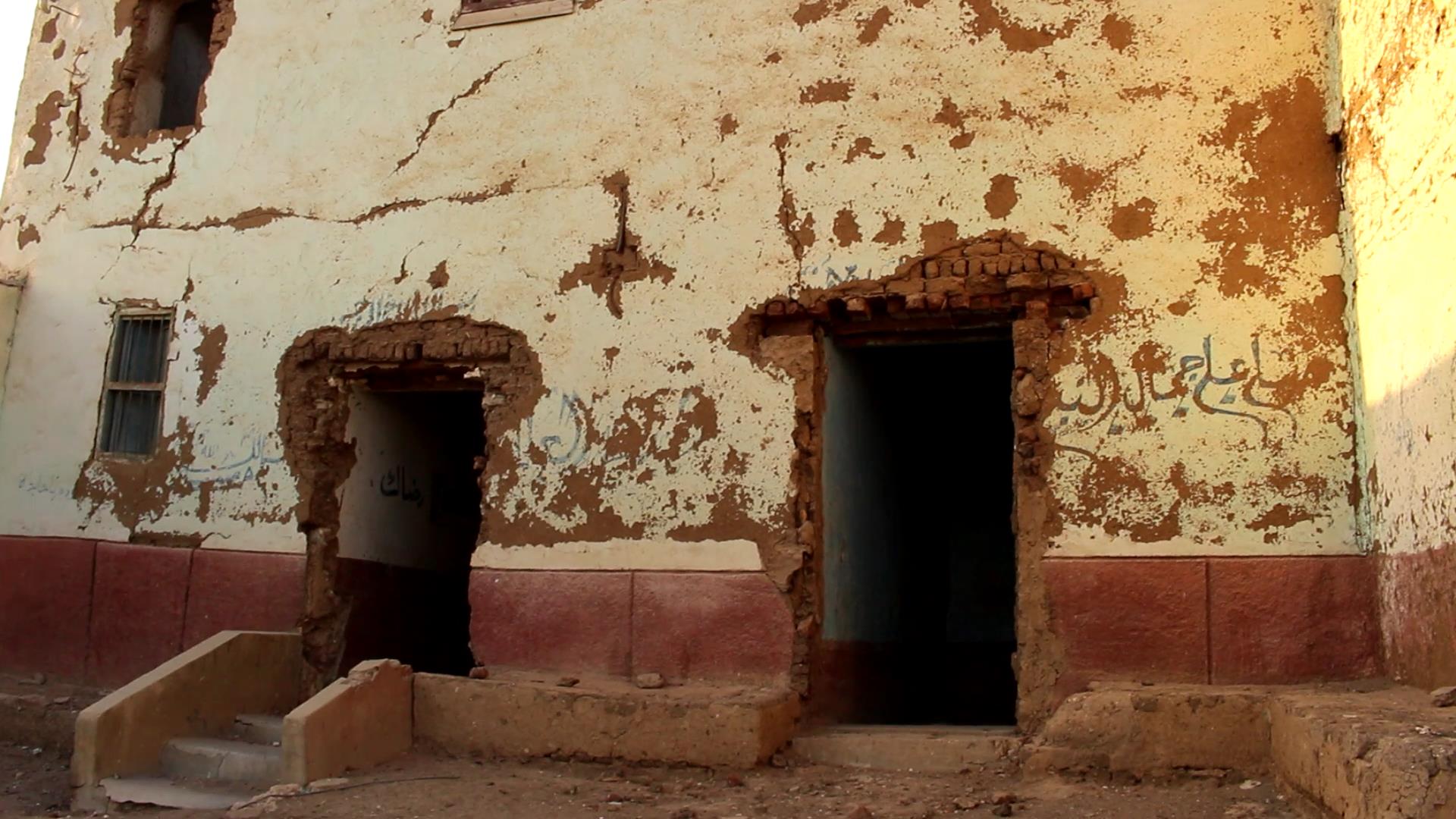
    The home of Rajab Shimi – Photo: Abo Elhassan Abd Elsattar

    Qurna and Ba’irat: A Lost Communion

    Old Qurna, in Rajab’s eyes, was not merely a location but a complete tapestry of life. It was a cohesive community without closed doors, where a neighbor might enter another’s home and open the refrigerator without a second thought. “We were one house; there was no distinction between Qurna and Ba’irat. We were a single soul,” he says. During the nights of the Moulid (religious festival), the village moved as one. Whoever owned a straw mat brought it; whoever had a water ewer shared it. Meals were a communal symphony, cooked together without the need for hired hands.

    Today, that world has undergone a stark transformation. In New Qurna, where the majority now reside, life wears a veneer of modernity, but Rajab finds it devoid of warmth. “You might not even know your neighbor. People ask questions not to offer comfort, but to pry into your affairs,” he remarks, drawing a sharp contrast between two eras.

    The shift was not merely social, but existential. Rajab recounts how the relocation severed the bond with the land. As fields grew distant from their owners, they were either abandoned or sold. “A man used to have his cow and his sheep; now he just sits on a bed in front of the television,” he says, lamenting the loss of the daily rhythm that once imbued life with meaning. As for him, he lives on the periphery of this change, tending a small plot of land with his brothers and clutching an old flour-trading license that has fallen into obsolescence. “No one is going to travel 15 kilometers just to collect a flour ration,” he says, noting the mountain’s divorce from the economic pulse of the valley.
    2 3 768x432
    2 1 1 768x432
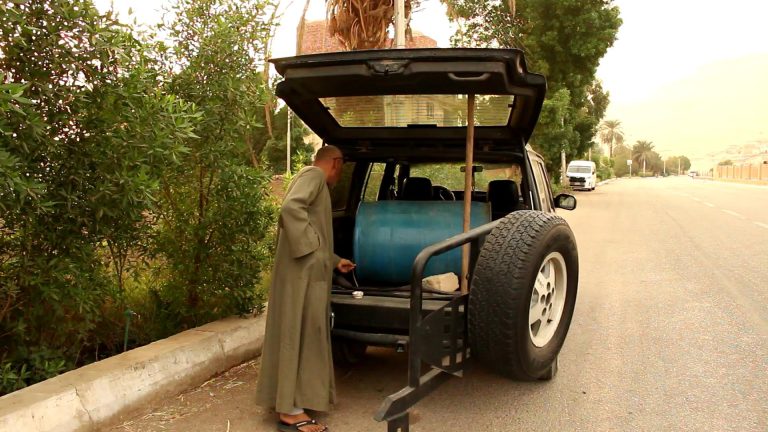
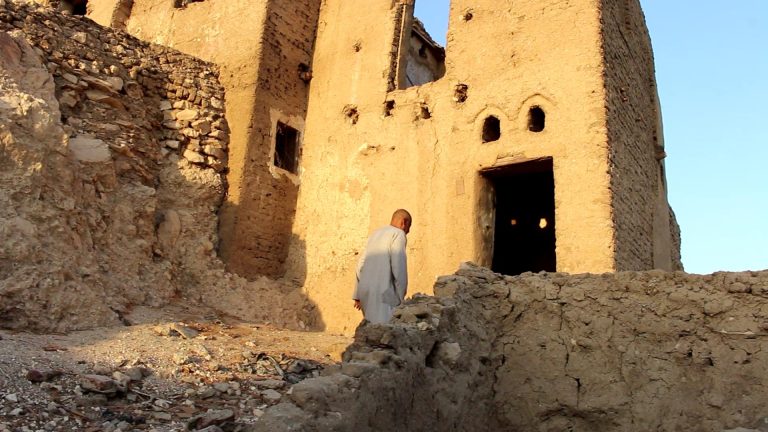
    The story of Rajab Shimi – Photo: Abo Elhassan Abd Elsattar

    The Burden of History

    Despite his proximity to the world’s most storied monuments—the Temple of Habu, the Colossi of Memnon, and the Valley of the Queens this geography does not grant Rajab a privilege so much as it deepens his paradox. He lives in the heart of history, yet remains outside the present. He watches the tourists pass by, greeting them with a few English phrases before retreating into his solitude.

    “We were guardians here more than anything else,” he asserts, an implicit defense against the long-standing stigma that linked the people of Qurna to tanqib (illicit excavation). He maintains that the vast majority were simple farmers and that the modern valuation of these treasures had not yet dawned on the people of old.

    Within the walls of this house, many narratives intersect: stories of displacement, of memory, of absent justice, and of social upheaval. Yet, in the final accounting, Rajab’s tale remains deeply personal. He is a man who found himself omitted from the ledgers of the living, choosin or perhaps forced to remain a ghost in his own home.

    When asked if the loneliness ever becomes a weight, he does not answer directly. He looks around at the mountain, at the hollowed, abandoned houses, and whispers: “The people were here. We were all here.” Perhaps that is the essence of his story: it is not that Rajab lives alone now, but that he continues to live among those who have long since departed.

    Archaeology Community displacement history luxor memory
    Share. Facebook Twitter Pinterest LinkedIn Tumblr Email
    Previous ArticleThe Social Ledger of Kafr al-Battikh: How a Tradition of Giving Evolved into an Economic Engine
    Next Article Shadows Over Antiquity: The Occupation’s Assault on Lebanon’s Living History
    Abo Elhasan Abd Elsattar

    Related Posts

    The Sanctuary of Saint Bishoy: A Living Ledger of Egyptian Monasticism

    2026-05-13

    Shadows Over the Nile: Concrete Construction Spark Criticism Beneath the Temple of Kalabsha

    2026-05-13

    The Damanhur Opera House: A Sovereign Union of Italian Elegance and Islamic Heritage

    2026-05-11

    Comments are closed.

    Recent Posts
    • The Woven Skeleton: The Palm Frond Artisans of Kafr Al-Battikh Fend Off a Plastic Tide
    • The Sanctuary of Saint Bishoy: A Living Ledger of Egyptian Monasticism
    • Shadows Over the Nile: Concrete Construction Spark Criticism Beneath the Temple of Kalabsha
    • The Damanhur Opera House: A Sovereign Union of Italian Elegance and Islamic Heritage
    • The Silent Outposts of Port Said: Ruins Beyond the Reach of Visitors
    Recent Comments
    • Binance美国注册 on An exhibition in Paris reimagines Cleopatra, far from Western narratives
    • binance "oppna konto on An exhibition in Paris reimagines Cleopatra, far from Western narratives
    • Binance账户创建 on Between popular religiosity and the benevolence of the Quran, how can beauty be reconnected with “Sayyida Zeinab”?
    • Binance创建账户 on Between popular religiosity and the benevolence of the Quran, how can beauty be reconnected with “Sayyida Zeinab”?
    • Skapa ett gratis konto on Central Ramses: Witness to Cairo’s transformations and the history of telecommunications in Egypt
    About Us
    About Us

    Your source for the lifestyle news. This demo is crafted specifically to exhibit the use of the theme as a lifestyle site. Visit our main page for more demos.

    We're accepting new partnerships right now.

    Email Us: info@example.com
    Contact: +1-320-0123-451

    Facebook X (Twitter) Pinterest YouTube WhatsApp
    Our Picks

    The Woven Skeleton: The Palm Frond Artisans of Kafr Al-Battikh Fend Off a Plastic Tide

    2026-05-14

    The Sanctuary of Saint Bishoy: A Living Ledger of Egyptian Monasticism

    2026-05-13

    Shadows Over the Nile: Concrete Construction Spark Criticism Beneath the Temple of Kalabsha

    2026-05-13
    Most Popular

    Shadows Over the Nile: Concrete Construction Spark Criticism Beneath the Temple of Kalabsha

    2026-05-135 Views

    The Sanctuary of Saint Bishoy: A Living Ledger of Egyptian Monasticism

    2026-05-132 Views

    Scientific trip to explore Upper Egypt temples

    2026-03-062 Views
    Demo
    Latest Posts

    The Woven Skeleton: The Palm Frond Artisans of Kafr Al-Battikh Fend Off a Plastic Tide

    2026-05-140 Views

    The Sanctuary of Saint Bishoy: A Living Ledger of Egyptian Monasticism

    2026-05-132 Views

    Shadows Over the Nile: Concrete Construction Spark Criticism Beneath the Temple of Kalabsha

    2026-05-135 Views

    The Damanhur Opera House: A Sovereign Union of Italian Elegance and Islamic Heritage

    2026-05-111 Views
    Stay In Touch
    • Facebook
    • Twitter
    • Pinterest
    • Instagram
    • YouTube
    • Vimeo
    Don't Miss

    Shadows Over the Nile: Concrete Construction Spark Criticism Beneath the Temple of Kalabsha

    By Bab Masr2026-05-13

    A controversy erupts in Aswan as new concrete structures at the Temple of Kalabsha spark…

    The Sanctuary of Saint Bishoy: A Living Ledger of Egyptian Monasticism

    2026-05-13

    Scientific trip to explore Upper Egypt temples

    2026-03-06

    Subscribe to Updates

    Get the latest creative news from SmartMag about art & design.

    Demo
    Demo
    Latest Posts

    The Woven Skeleton: The Palm Frond Artisans of Kafr Al-Battikh Fend Off a Plastic Tide

    2026-05-140 Views

    The Sanctuary of Saint Bishoy: A Living Ledger of Egyptian Monasticism

    2026-05-132 Views

    Shadows Over the Nile: Concrete Construction Spark Criticism Beneath the Temple of Kalabsha

    2026-05-135 Views

    The Damanhur Opera House: A Sovereign Union of Italian Elegance and Islamic Heritage

    2026-05-111 Views
    Stay In Touch
    • Facebook
    • Twitter
    • Pinterest
    • Instagram
    • YouTube
    • Vimeo
    Don't Miss

    Shadows Over the Nile: Concrete Construction Spark Criticism Beneath the Temple of Kalabsha

    By Bab Masr2026-05-13

    A controversy erupts in Aswan as new concrete structures at the Temple of Kalabsha spark…

    The Sanctuary of Saint Bishoy: A Living Ledger of Egyptian Monasticism

    2026-05-13

    Scientific trip to explore Upper Egypt temples

    2026-03-06

    Subscribe to Updates

    Get the latest creative news from SmartMag about art & design.

    Demo
    About Us
    About Us

    Your source for the lifestyle news. This demo is crafted specifically to exhibit the use of the theme as a lifestyle site. Visit our main page for more demos.

    We're accepting new partnerships right now.

    Email Us: info@example.com
    Contact: +1-320-0123-451

    Facebook X (Twitter) Pinterest YouTube WhatsApp
    Our Picks

    The Woven Skeleton: The Palm Frond Artisans of Kafr Al-Battikh Fend Off a Plastic Tide

    2026-05-14

    The Sanctuary of Saint Bishoy: A Living Ledger of Egyptian Monasticism

    2026-05-13

    Shadows Over the Nile: Concrete Construction Spark Criticism Beneath the Temple of Kalabsha

    2026-05-13
    Most Popular

    Shadows Over the Nile: Concrete Construction Spark Criticism Beneath the Temple of Kalabsha

    2026-05-135 Views

    The Sanctuary of Saint Bishoy: A Living Ledger of Egyptian Monasticism

    2026-05-132 Views

    Scientific trip to explore Upper Egypt temples

    2026-03-062 Views
    © 2026 ThemeSphere. Designed by ThemeSphere.

    Type above and press Enter to search. Press Esc to cancel.